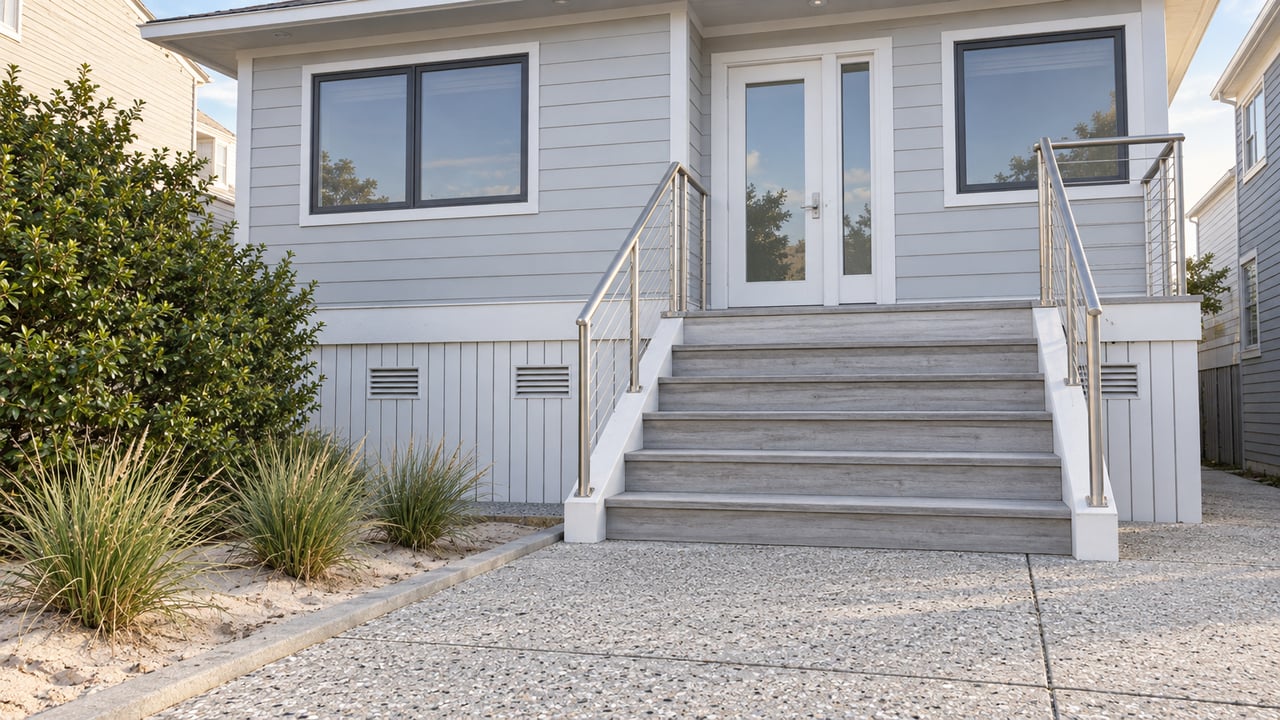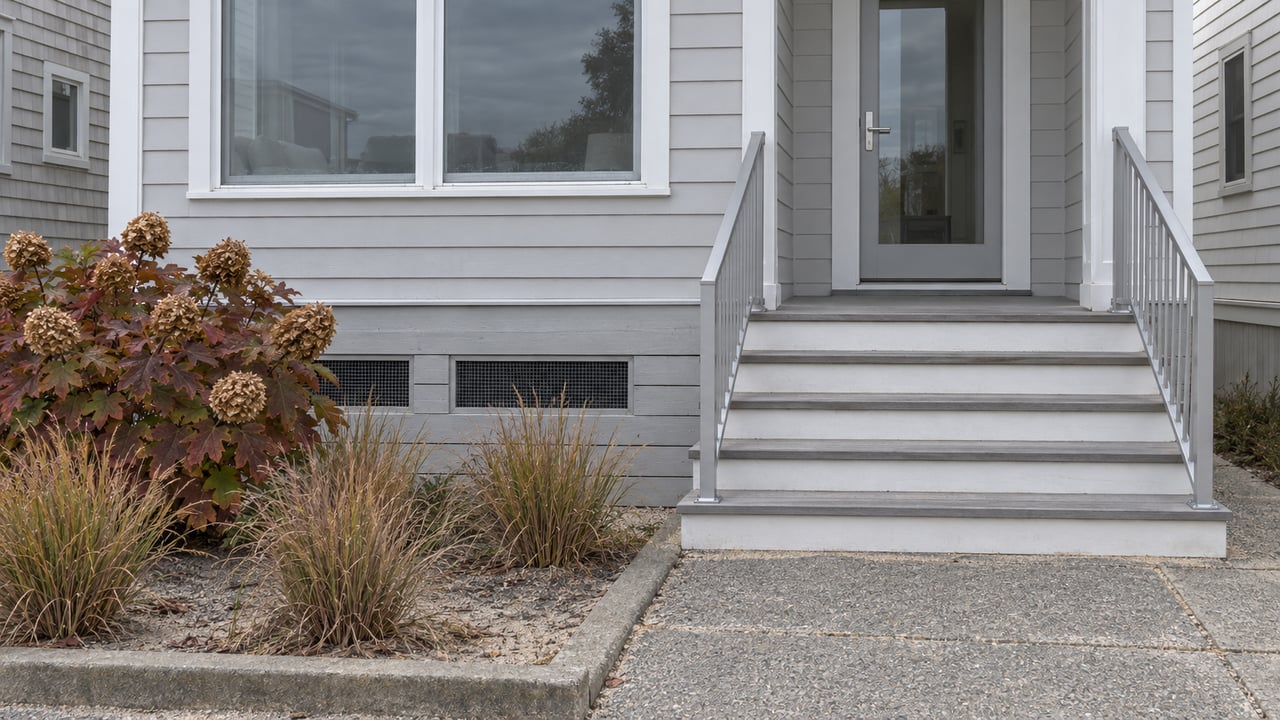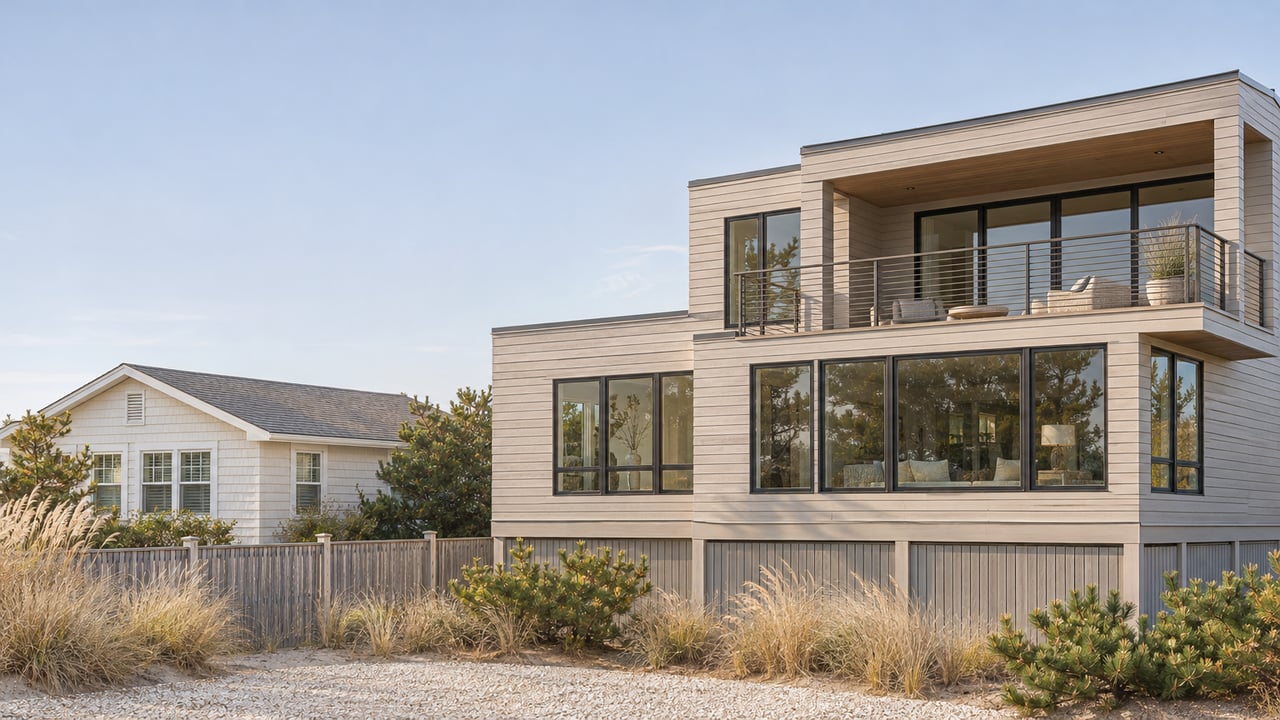
Picture two 1970s cottages on the same Brant Beach street. They have the same lot size, the same flood map and the same buyer pool. The owner of one hired an architect last spring and filed a complete application with the New Jersey Department of Environmental Protection. The owner of the other has a set of sketches. Under the state's new coastal flood rules, the replacement houses on those two lots can be held to different elevation standards. That stays true until July 20, 2027, which is about eight months after this post goes up.
The difference doesn't appear on a listing sheet or a tax card, and the photographs won't show it. It sits in a permit file, and in Long Beach Township right now that file is part of what a buyer is paying for.
The Number Written Into General Permit 6
New Jersey's Resilient Environments and Landscapes rules, known as REAL, took effect on January 20, 2026. Along tidal waters, the rules set a "climate-adjusted flood elevation" four feet above the 100-year flood elevation. When a DEP delineation and FEMA mapping both exist, the higher of the two is used. The FEMA figure comes from the most recent effective, advisory, preliminary or pending map.
Most single-family rebuilds on the island deal with a second layer as well. The DEP authorization that covers one single-family home or duplex is General Permit 6 under N.J.A.C. 7:13-9.6. It requires the lowest floor to sit "at least one foot above the climate-adjusted flood elevation and no lower than the elevation required pursuant to the Uniform Construction Code." Where the FEMA figure controls, that puts the minimum at five feet above base flood elevation, or higher if the Uniform Construction Code requires more. The same permit has its own eligibility conditions. The lot can't have been created or subdivided after November 5, 2007, nothing can be built in a floodway or inundation risk zone, and any enclosure below the lowest floor has to stay non-habitable and open to floodwaters.
The municipal side is a separate track. The state Department of Community Affairs, in its Uniform Construction Code overview, describes the construction permit as a requirement that your town administers, apart from DEP. A homeowner can satisfy the township building office and still owe DEP a higher number.
The rules reach new construction, redevelopment and substantial improvements, not existing homes left as they are. DEP also says elevation is not required where it is impracticable. Under the flood hazard rules, a substantial improvement is measured against a threshold of 50 percent of the structure's market value, with costs counted cumulatively. That threshold is why a large renovation and a teardown can end up in the same conversation.
Why the Calendar Now Outweighs the Map
When REAL was adopted, it included a 180-day legacy period that let certain applications be reviewed under the earlier rules. That window was set to close on July 20, 2026. DEP adopted amendments on August 27, 2026, effective September 21, 2026, that extended it to July 20, 2027, citing Governor Mikie Sherrill's Executive Order No. 5 and the department's plan to review REAL for "efficiency, consistency, and accountability."
For a lot that was already inside a flood hazard area before January 20, 2026, DEP's legacy provisions guide says what qualifies:
- A complete application for a verification, general permit or individual permit.
- Submitted to DEP before July 20, 2027.
- "Complete" means both administratively and technically complete when it arrives.
- Using the "Bill Me" function on DEP's portal leaves an application administratively incomplete until the fee is paid.
DEP doesn't have to rule on completeness before the deadline. An application received in time can still qualify if the department later finds it was complete when first submitted. If the department finds it incomplete and the applicant resubmits after July 20, 2027, the project loses legacy status. The guide sets out the stakes in two examples that differ by one fact:
An applicant submits an application for an individual permit on July 18, 2027. Two weeks later, the Department determines that the application, as received, is administratively and technically complete. The application is therefore subject to the FHACA rules adopted on July 17, 2023.
In the second example, the same filing is found incomplete and falls under the January 20, 2026 rules.
What Changes Hands With a Teardown Lot This Winter
This is where the rule turns into a pricing question. When an older house in Loveladies, North Beach or Brant Beach sells to someone who plans to rebuild, the buyer is pricing a future house, and the height of that house's lowest floor shapes its stairs, its elevator, its roofline and its cost. A seller whose architect and engineer have a complete DEP filing in by the deadline can hand over a project with a known rulebook. A seller with nothing on file is offering a lot whose rulebook depends on how fast the next owner moves, and, after July 20, 2027, on whatever DEP decides in the meantime.
| Question about the lot | Where the answer lives |
|---|---|
| Was a DEP application submitted, and on what date? | The owner's design team and DEP's records |
| Was the fee paid, or was "Bill Me" used? | The application receipt |
| Has DEP ruled the application complete? | DEP correspondence |
| Does the lot meet General Permit 6 conditions, including the November 5, 2007 lot date? | Survey and deed history, reviewed by the design team |
| Is any coastal permit needed as well? | A site-specific review |
That last row matters on the oceanfront. Away from the beach and dune zone, the Coastal Area Facility Review Act's residential trigger is generally a development of 25 or more units, but projects near the mean high water line follow different thresholds. Where a coastal permit is required, General Permit 4 covers one or two homes, subject to its conditions. Every one of these answers depends on the parcel, and a contract can be written around any of them.
A buyer looking at a renovation can ask the same questions. The 50 percent substantial improvement threshold counts costs cumulatively, so earlier permitted work on a house can matter to the next owner's plans.
Township Hall Is Still Pushing for Changes
The July 2027 date may not hold, because the island's elected officials have spent the year trying to change the rule itself.
Before adoption, Long Beach Township said in a July 2025 statement that the standard should be base flood elevation plus two feet, with a five-year review. After the rule took effect, Mayor Joseph Mancini told The SandPaper that the January 20 effective date "was mean-spirited" and that the rule "needs to be rescinded." In June, when the extension was proposed, he told The SandPaper that "the extension does not address the fundamental problem," and that homeowners "must still bear thousands of dollars in upfront costs." On October 30, 2026, the township posted a release titled "LBT Demands Relief as state's REAL rules impose crushing burden on shore homeowners."
Other towns on the island are involved too. The SandPaper reported in July that Harvey Cedars Mayor John M. Imperiale had joined a REAL working group formed by the New Jersey Council of Mayors. In January, Barnegat Light planned to amend its building-height ordinance to account for the higher state elevations, according to The SandPaper.
At the State House, positions are still split. NJ Spotlight News, republishing New Jersey Monitor, quoted Senate President Nicholas Scutari welcoming the delay. Ray Cantor of the New Jersey Business & Industry Association urged the administration to "start from scratch." Doug O'Malley of Environment New Jersey said the delay gives developers "another year of using antiquated data." DEP's own notice says it is considering "targeted amendments" to simplify permitting while keeping the rules' goals, and that any amendments will go through the Administrative Procedure Act.
Questions Sellers and Buyers Raise
Does REAL require an existing Long Beach Township home to be raised?
DEP says the standards apply to new development, redevelopment and substantial improvements, not to existing development as such.
Is the township's elevation requirement the same as DEP's?
Not necessarily. General Permit 6 sets the lowest floor at one foot above the climate-adjusted flood elevation and no lower than the Uniform Construction Code elevation, so the stricter of the two applies. The Long Beach Township Construction Office handles the local side.
Does submitting by the deadline guarantee the old rules?
Only if the application was administratively and technically complete when DEP received it, as the legacy guide's examples show.
This post is general information about a state rule. It isn't legal, engineering or financial advice, and every parcel should be reviewed by your architect, engineer, attorney and the township before you rely on any of it.
If you own an older home in Long Beach Township and want to know how a permit file, or the lack of one, will look to buyers before July 20, 2027, Coastal Living Real Estate Group can walk you through how we would present it. Request a Complimentary Coastal Market Evaluation.